Does it Matter?
By Beverly Faxon
Few words drive me quite as crazy as these: “Voting doesn’t matter.”
Years ago, a friend and I discussed two presidential candidates. I said that if her candidate won, I feared that a right we both supported, and that we had all lived with for decades, might be rescinded.
Oh, no, she assured me. Never. That right was a law, set in stone. Her candidate won, and for once, I found it a small consolation when I was eventually proven right. Yes, voting matters.
As I write this, the Skagit Valley Herald reports that the Sedro-Woolley School District’s February replacement levy for Educational Programs and Operations has passed. The vote count seesawed for ten days after the election, and the final margin was just over 100 votes.
Do our votes make a difference? Ask someone who supported the recent school levy in Sedro-Woolley, and made sure to cast a ballot. Or ask someone who was against the levy, but didn’t get around to voting. On a national scale, whether or not we like what’s been happening in our country since the 2024 elections, it would be hard to argue that it didn’t much matter which candidates got elected. We’ve seen it firsthand: voting impacts our lives.
2026 may be an election year, but the November elections are months away. Why an article about voting when our minds are pulled to tulips, curly rhubarb leaves pushing upward, and the sunny relief of lengthening days?
Co-op Board Elections
First, because we get a chance to flex our voting muscles right here, right now, at the Co-op.
Since I’m a believer in voting pretty much every chance we have, it’s gratifying to know we can start this month at the Co-op. Our Co-op is owned not by a handful of rich corporate owners, but by all of us, thousands of member-owners. We operate democratically to vote for and elect the members of the Board of Trustees, who serve on our behalf. They are an active board, making decisions that shape the vision, direction, and practices of the Co-op.
This spring, two positions are open on the Co-op Board, and four member-owners are running. Ballots are available as of April 1. A cut-out version of the paper ballot is in this issue of the Enquirer, and print paper ballots are available in-store by the ballot box. Online voting is also available as of April 1—you can vote here. Elections run through 5:55pm on the day of the Annual Meeting, May 13.
2026 State and Local Elections
Second, because now is the time to make sure that strong candidates, who will represent your interests, run in state and local elections in 2026.
Perhaps you know someone you might encourage to run? Perhaps you’d like to run yourself?
Don’t count out the possibility of creating changes you care about. We have more power than we imagine we do. This past fall, Sammy Solano Rivera unseated an incumbent for a position on the Mount Vernon School Board. At 19, Sammy is the youngest board member in Mount Vernon history. He and his campaign manager, Sayer Theiss, a fellow 2025 graduate, ran a grassroots campaign, with the purpose of “advocating for students, teachers, and paraeducators.”
When the campaign started, I imagine it looked like a long shot. I have to wonder how many people told Sammy, “No way, Sammy. Go ahead and run, but it really won’t matter.” Yet it did matter, and so did the votes of everyone who checked the box next to his name on their ballots.
In Washington State (with some exceptions), odd years are for non-partisan elections (like school boards and county councils), while even years host elections for partisan offices. In 2026, we will see elections for some key congressional seats, at both the federal and state levels. We will also see elections for seats that, at one time, may have seemed routinely administrative, maybe a little boring, but now feel crucial. The role of county auditor, for example, has taken on increased significance as people look closely at election integrity and access for all eligible voters.
In fact, we are finding every local position shapes how we live, learn, earn our wages, even survive floods. We may understandably get caught up in drama at the national level, but we are learning our state and local governments often are the frontline to nurture, defend—or undermine—our everyday lives (and our democracy). Who we elect—for auditor, sheriff, attorney general, mayor, county commissioner, school board—matters.
Filing week for Skagit County, online and in-person, is May 4-8. Filing by mail begins April 21. For more information, including a list of offices up for election in 2026, visit the Skagit County website.
Turning Anxiety Into Action
Third, if you are already thinking of, and maybe even anxious about, the November elections, it is not too early to turn that anxiety into action.
Find political parties, organizations, and candidates that align with your views, from the local to the national. Support their work, through your money, time, or your ability to share their information. This could take many forms, depending on your resources, your comfort level with engagement, and even your willingness to travel. Grassroots groups have sprung up to phone bank or doorbell for candidates, and to write postcards simply encouraging eligible voters to go to the polls, or more specifically, to vote for a candidate.
Finally, aside from filing for local office, supporting the candidates of our choice throughout their campaigns (by action or donation) and eventually VOTING, what can we do?
Everything possible to guarantee that all eligible voters can cast their ballots, and that every ballot they cast is counted. No matter what political disagreements we might have, almost all of us agree: as eligible voters, we want to choose our leaders, who are our representatives in a democracy. We don’t want leaders of any party, hoping to seize or hold power, to pass laws blocking qualified voters from voting.
Check your own voting registration status, or help those you know check theirs. The National Association of Secretaries of State maintains a website for helping people register to vote, update their information, or see if their ballot has been successfully received. (www.nass.org/can-I-vote/voter-registration-status)
Get involved in voter registration. I have a friend who has found working with the League of Women Voters to be a rewarding way to have conversations with community members, while helping them secure their right and responsibility to vote.
Stay tuned for any legislation that could change voting laws, and let your legislators know your response. Want to preserve your right to vote by mail? Uncomfortable with the idea that voters might be required to show government-issued ID at the polls? (Do you know where your birth certificate is? Do you have a passport?) Voting rights legislation and protection might not make for flashy reading when we are scrolling through news feeds or social media, but it is crucial, in-the-trenches work.
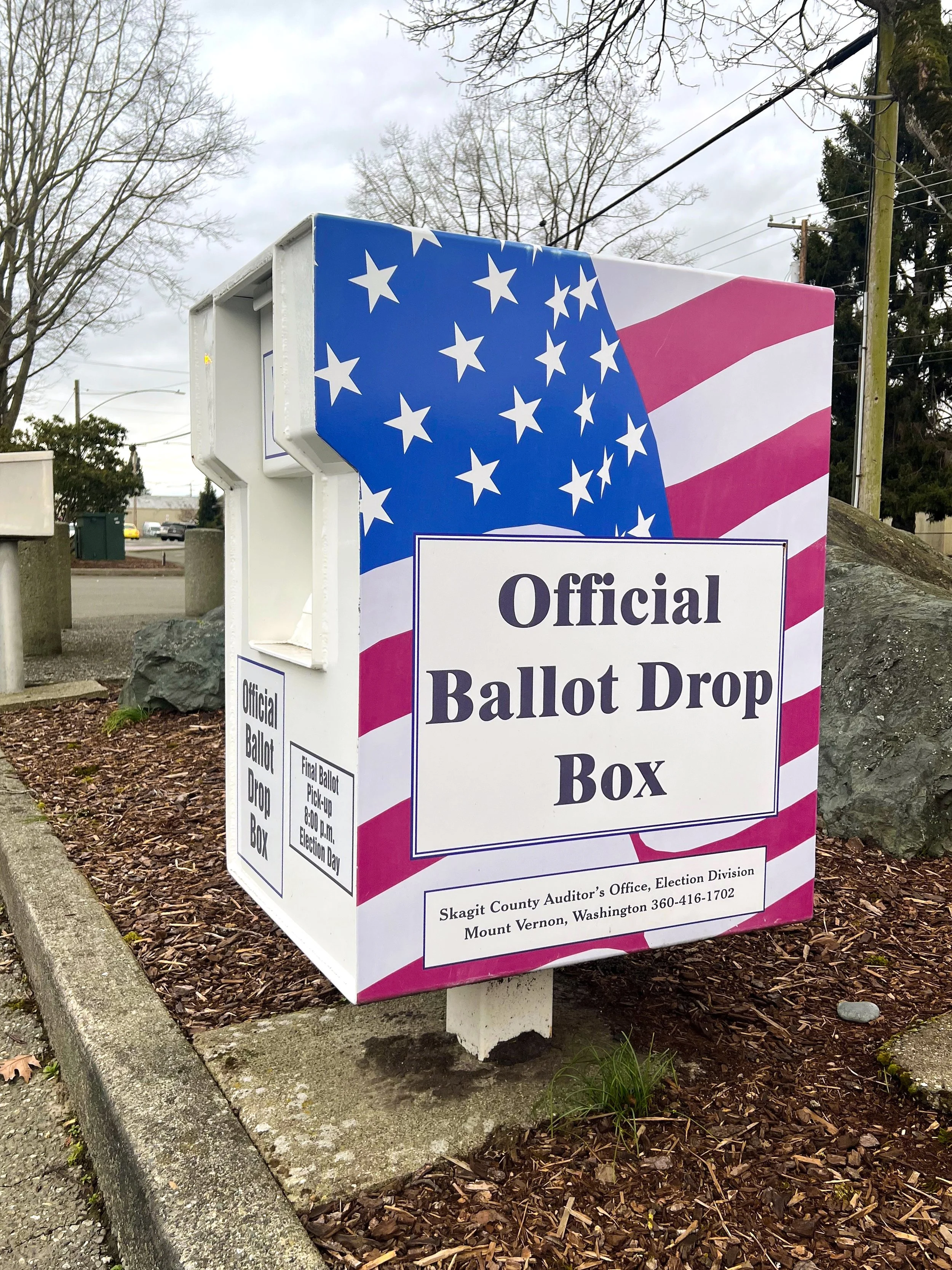
Spread the word about how recent changes in postmark rules could keep a mail-in ballot from counting. Washington is one of a number of states that has historically counted a mailed ballot received within a predetermined number of days after Election Day, as long as it was postmarked by Election Day. This practice was possible because, until recently, all mail was postmarked the day it was deposited, at the post office where it was deposited. New postal rules say that mail may now be postmarked at central hubs, rather than at the local offices where it is deposited, a policy that could delay the date of the postmark. The take-away: deposit ballots in an official ballot box or, if mailing, mail well in advance—don’t wait until the last minute.
Come August for the primaries, and November for the general election, we can vote for the world we want to live in. Between now and then, there will be plenty of opportunities to act, because it matters.