Viva Farms Practicum Student Story: Rowdy Sprout Farm
by Kirsten Murray, Co-owner of Rowdy Sprout Farm and Viva Farms Practicum Class of 2025
Viva Farms is a nonprofit farm business training program and incubator farm with locations in both Skagit and King County. Our mission is to empower aspiring and limited-resource farmers by providing bilingual (Spanish-English) training in holistic organic farming practices, as well as access to land, infrastructure, equipment, marketing, capital, and community. We are growing farmers, community, and food. Later this month, we welcome our next cohort of students in the Practicum in Sustainable Agriculture. We are thrilled to share a 2025 graduate’s reflection with the Skagit Valley Food Co-op community.
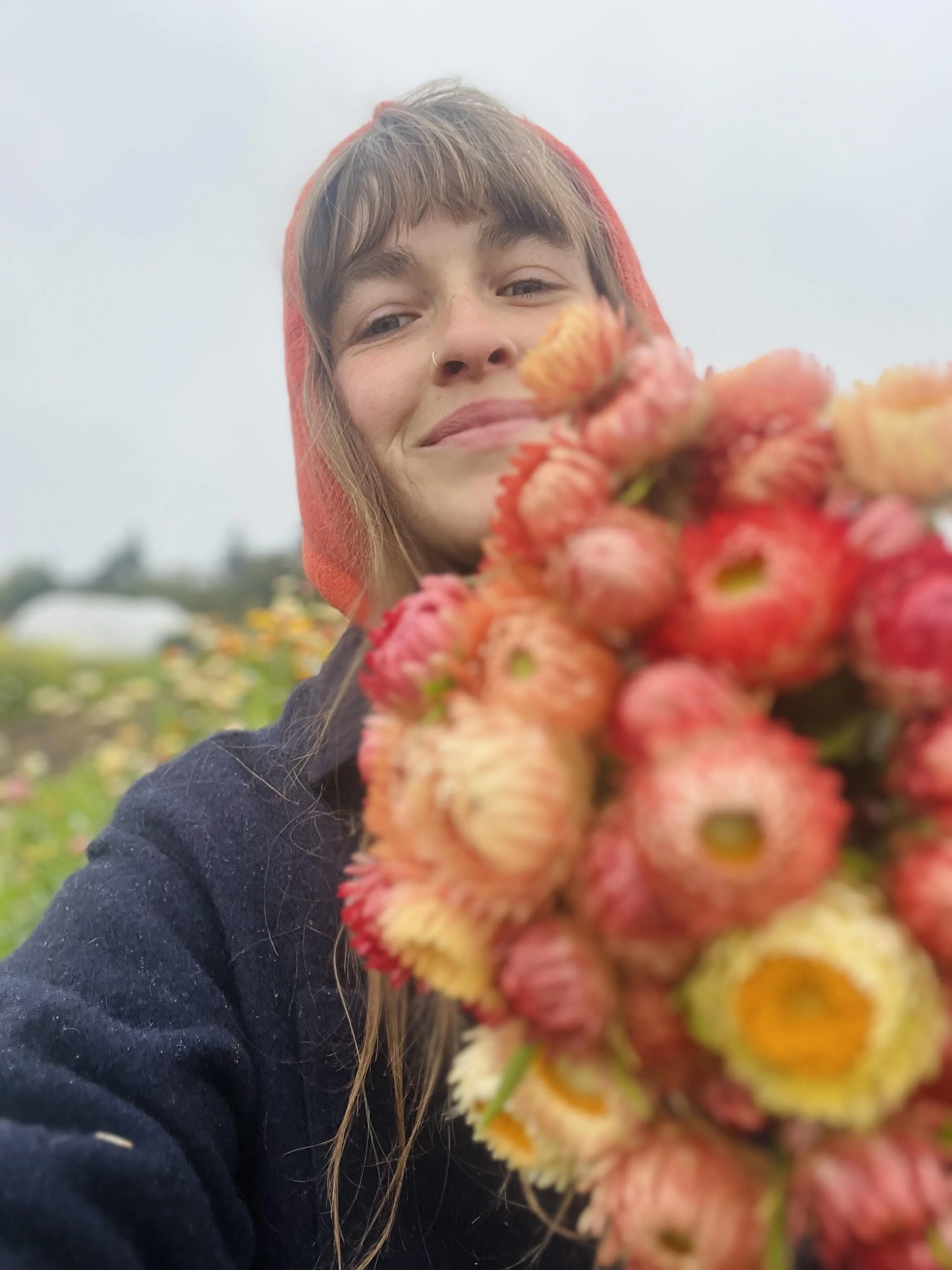
Kirsten Murray of Rowdy Sprout Farm
I have worked in or adjacent to agriculture for over a decade, with small farms and in urban and school gardens. I am also a certified master gardener and previously worked in outreach for a regional farmer training program. At every turn of my life, since my early twenties, I have put myself in the way of learning and experiencing different aspects of farming. All this considered, it might surprise some to learn how many foundational holes I found myself facing when I struck out to establish my own farm.
When training employees, quite often the reality is that farmers/small business owners either don’t have time to deeply elaborate on every practice within their production, or lack the desire to. They tell you how to prune it, seed it, transplant it, harvest it, wash it, pack it—and you’re off and running. In my experience, farm managers also look to capitalize on what you are good at and keep you focused on those tasks. As an example, I’ve got a keen eye for quality. I pack a mean CSA box, and I genuinely enjoy face-to-face time with customers, so wash-pack and the market circuit made sense for me. Except, I wanted to learn everything, and even within the areas I was focused on, there was little time for asking “why?”, much less getting an answer. To own your own farm, whether you are generous with the information or not, you need to know the why of everything.
I believe this to be, on one hand, a recently heightened conundrum in farming related to the stark decline of the family farm, and on the other, a continued commitment to an age-old metaphoric line in the soil which kept the farmer on one side, and the farm worker on the other, essentially cut off from crossing over by a lack of knowledge, as much as a lack of inheritance. Once upon another generation, the details of production were passed down within families; “the farmer” was raised with an intimate proximity to the work, and an inheritance to it. Their education was built into their childhood. Whether by circumstance or design, continuing this incomplete transfer of knowledge in today’s ag climate will actively contribute to the collapse of our regional and local food systems as we know them—unless a crop of new, more accessible sources for preparing the next generation of farmers were to emerge from the ashes of the old system.
Opinion: Viva Farms is every bit the phoenix we have needed.
The eight months I spent participating in their Practicum in Sustainable Agriculture not only gave me ample opportunity to ask all the questions I have collected over the last decade, both in the field and in the classroom, but it also outfitted me with a strong community and access to essential resources in perpetuity. The structure of this program, geared towards working people, and offering full scholarships, made my attendance possible. From irrigation to propagation, bookkeeping to marketing, our class was invited to the subject table with open arms week after week. No gatekeeping, and all within a gorgeous culture of curiosity, excitement, and gumption, constantly exemplified by Viva staff. I often found myself looking around the classroom or across the field and thinking, “If only I’d had access to this 10 years ago.” And feeling intense joy for classmates at the beginning of their journey with farming, starting out under such ideal germination conditions.
It’s the kind of introduction to agriculture that makes you want to stay, makes you believe you’ve got a fighting chance. Viva cannot quench the thirst of the hottest days of summer, or disappear the stress of keeping your Organic or GAP certification documents in order, but they can, and do, make you feel like you’re not alone in any of it. To be stuck in the literal or metaphorical mud and know exactly who to call to help spring you free, is the greatest gift a farmer could ask for in their career.
With opportunities to incubate on Viva’s land after graduating from the Practicum, staff support navigating funding paths and business development, continued access to specialty seminars and workshops (all bilingual, I must add!), and more. Viva Farms goes above and beyond remedying the educational gap. They are carving a whole new pathway from dream to sustainable reality for aspiring farmers, and I couldn’t be more grateful to now be on that path with them.
Kirsten Murray co-owns Rowdy Sprout Farm with her partner Tommy Contreras. They presently farm on incubator land on the South End of Whidbey Island, and are actively searching for permanent land access in the region. Learn more about their farm by visiting rowdysproutfarm.com.