Community In Practice
by Bev Faxon
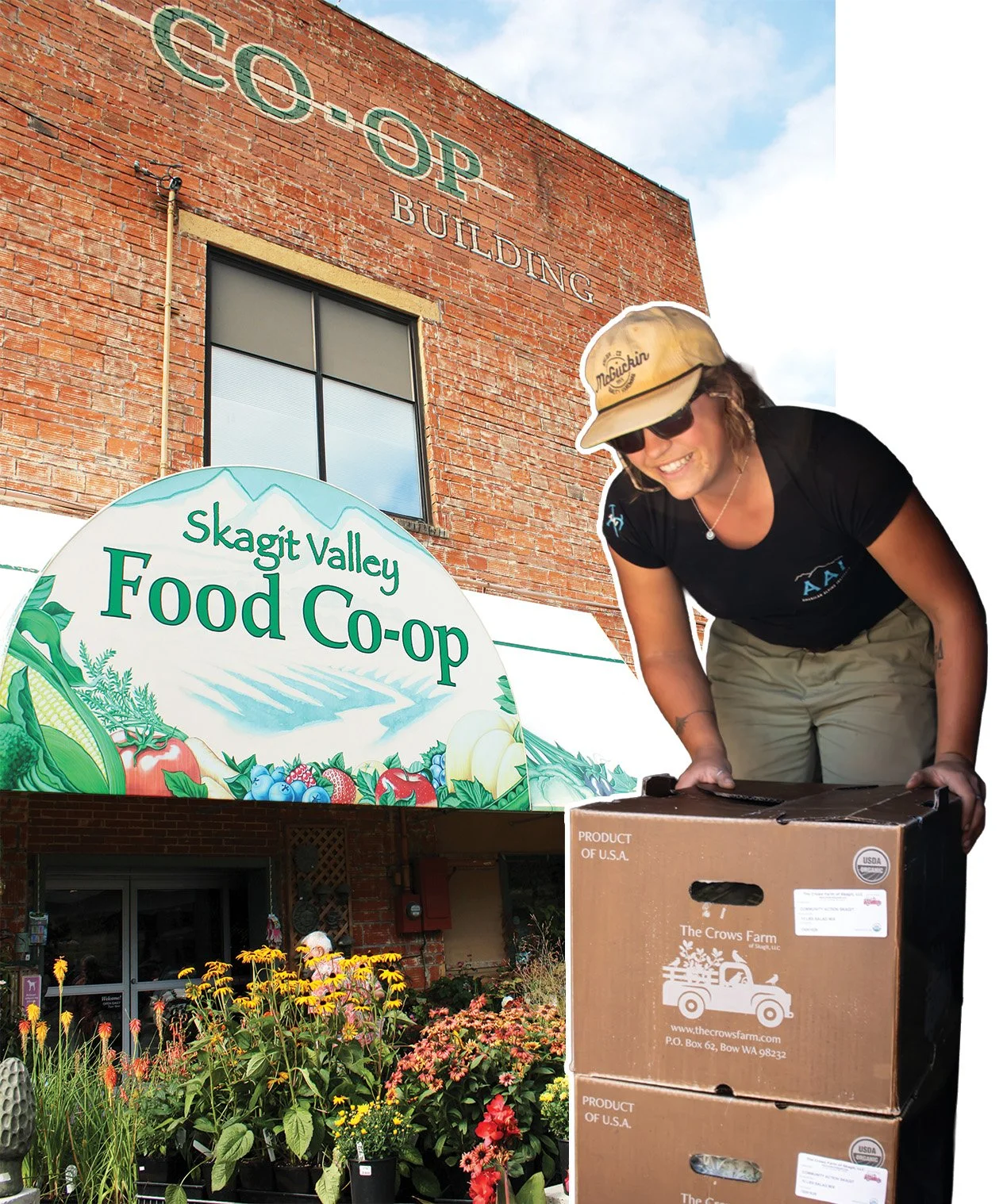
It’s hard not to imagine “Co-op” as synonymous with “Community.” Co-ops are, after all, cooperatively and community owned. From the earliest days, Co-op members have worked together, compromised, and considered different viewpoints in order to thrive.The farming community, the worker community, the community of the gluten-free, the community of the not-for-profit business model—all these communities and more are supported by the Co-op.
Yet, despite all this, the “Co-op Equals Community” equation isn’t a given, something we can take for granted. Community requires people to commune: to interact, to be present with one another. And many of us are a little rusty at communing. The welcome news is that the Co-op, our Co-op, is a perfect, low stakes, high reward spot to practice the fine art of being in community. The first question, though, may be—why bother? Why not keep our heads down, put our Cosmic Crisp apples and fresh baguettes in our carts and just check out?
For many of us—and it matters not where we are on the political spectrum—life feels uncertain and uneasy. We hear that, as a rule, people don’t do well without contact with other people, and just as importantly, that society suffers unless people willingly check in with each other—preferably, in the real world, in real time, in their real, 3D skins. Isolation can be a precursor to feeling helpless in the world, and without contact and support, we are more apt to view each other with distrust and suspicion. Community right now is not just an admirable idea, but essential. Community may be what pulls us back from the brink of both despair and division.
Derek Thompson published “The Anti-Social Century” in The Atlantic in February 2025, a time when many of us were regrouping and wondering what would come next. One of Thompson’s ideas sticks with me. Imagine we live in three concentric social rings—three circles reshaped perhaps by the COVID years of isolation and by an exponentially growing reliance on online communication. The innermost circle is the intimate realm of friends and families. The outermost circle is the group Thompson calls “our tribe,” where we find accord with, and reinforcement for, our beliefs. This outer circle is now often online, the expansive group (often far-flung) whose communications mirror, support, and entrench our own beliefs.
In between, and largely missing these days, is the middle circle: the village. If you are a reader of cozy English mysteries, you know the idyllic (if occasionally lethal) version of this world—the village baker; the chemist (oops, pharmacist); Tommy, that charming rascal whose parents own the sheep farm; the people who rub elbows every Saturday at the market and who debate with one another in town council meetings. In the middle circle, our belief systems may diverge, and we may share no political alliance, but we share the same physical space, and some of the interests that come with that proximity.
Why does this middle circle matter? Because, Thompson tells us, it is this circle where we learn to get along, where we learn to practice tolerance. This circle is the “key to social cohesion.” This is the layer where we stop seeing people as cardboard cut-outs or disembodied voices spouting ideas we don’t understand or we actively dislike. We see them instead as real people (possibly spouting ideas we don’t understand or we actively dislike).
But we also begin to see that they are more than those ideas—that they, too, have children they worry about; or that they, too, are quietly relieved when the fall rains come back; or they, too, wait all year for local strawberries, Oregon melons, and the arrival of fresh satsumas and pomegranates. And as we see this, perhaps we feel less polarized, perhaps we feel less frightened, perhaps we see each other less as immovable adversaries. Perhaps strangers become less threatening, and finding common ground becomes more possible.
Some of us discover middle circle groups to join or to attend regularly: school board meetings or school fundraising groups; local government councils; volunteer opportunities at a food bank or a hospital or a trail building group. We take a quilting class or go to the gym. All provide opportunities, if we take advantage of them, to support and build the middle ring.
And, although for some the Co-op is part of an intimate inner circle, and for others it is part of the tribe of similar thinkers, I would suggest that for most of us, the Co-op, like the marketplace in the square, is one place to gently practice community interaction within the middle circle. Assumptions aside, not everyone at the Co-op shares the same worldview or the same political stance. But everyone is accepted as part of the Co-op community.
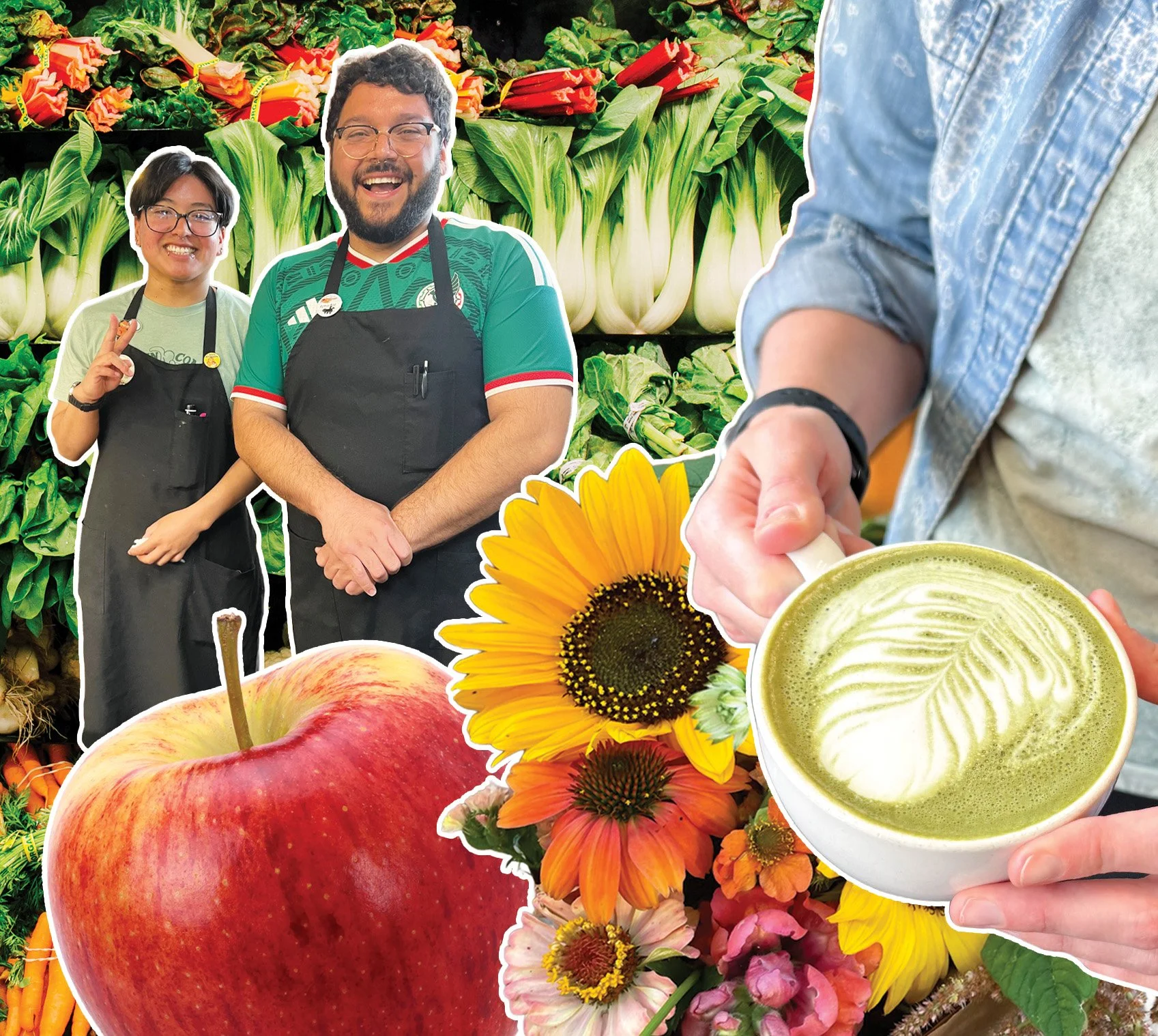
Every practice of being present at the Co-op, with a receptivity and openness, can be rewarding. Rewarding to the senses, certainly. (Just look at that rainbow chard. And the smell of coffee. And the taste of those cheddar samples.) But rewarding, too, when we notice the people around us and take even the smallest opportunity to connect: the nod, the smile, the offer to help someone who is standing in the bulk aisle, looking bewildered. Every time we visit, we have a chance to practice just one conversation, no matter how brief, with someone we know only by sight, or don’t know at all.
Each smile or nod puts a stitch in the net of social cohesion. And in these small ways, we reinforce, for ourselves and others, that strangers don’t need to signal alarm. We remind ourselves that we are all in this together.